English


When a purchase order for stainless steel washers lands on your desk, the line item may look simple: M8 flat washer, 304 or 316. Yet the grade choice can decide whether an assembly survives a coastal plant, a food washdown line, or a chemical skid. What Is the Difference Between AISI 304 and 316 Stainless Steel Washers? In practical procurement terms, the difference is not just chemistry on a mill certificate; it is chloride resistance, lead time, price volatility, and the risk of a rework ticket six months after installation. AISI 304 washers use 18/8 chromium-nickel chemistry and suit dry indoor equipment, general fastening, and many clean environments. AISI 316 washers add molybdenum, which strengthens the passive film against chlorides and helps in marine, pharmaceutical, and aggressive washdown conditions. The wrong call goes two ways: paying for 316 where 304 would last, or saving pennies on 304 where pitting will start at the washer face. This guide is written for buyers, engineers, and maintenance teams who need a clear specification, a fast quote, and a reliable source. Ningbo Kaxite Sealing Materials Co., Ltd. supplies both grades with dimensional checks, material traceability, and export-ready packaging, so you can compare the real cost of each option before you commit.
The common pain scene is a buyer comparing two quotes that look identical except for grade and price. The line item says “stainless steel washer,” but one supplier offers AISI 304 and another offers AISI 316. Without a clear grade comparison, the lowest price can look like the safest choice, even when the service environment demands molybdenum-bearing steel. A practical solution is to lock down chemistry, standard, and dimensional tolerances before asking for price. AISI 304 is the general-purpose austenitic grade with 18% chromium and 8% nickel. AISI 316 adds 2–3% molybdenum, which improves resistance to chlorides and pitting. For washers, the grade must also match the bolt, nut, and joint design; otherwise, galvanic effects, galling, or hydrogen-assisted cracking risks may be misread. Ningbo Kaxite Sealing Materials Co., Ltd. helps procurement teams review the application, confirm the washer standard, and issue a grade-specific quotation for AISI 304 or 316 stainless steel washers.
Table 1: Typical Grade and Washer Parameters
| Parameter | AISI 304 Washer | AISI 316 Washer |
|---|---|---|
| Common UNS grade | S30400 | S31600 |
| Key chemistry | Cr 18–20%, Ni 8–10.5%, Mo 0% | Cr 16–18%, Ni 10–14%, Mo 2–3% |
| PREN range | Approx. 18–20 | Approx. 24–28 |
| Typical washer standard | ISO 7089, DIN 125, ASTM F844 | ISO 7089, DIN 125, ASTM F844 |
| Common M8 flat washer size | ID 8.4 mm, OD 16 mm, Thk. 1.6 mm | ID 8.4 mm, OD 16 mm, Thk. 1.6 mm |
| Best-fit environment | Indoor, dry, general equipment | Coastal, washdown, chemical, marine |
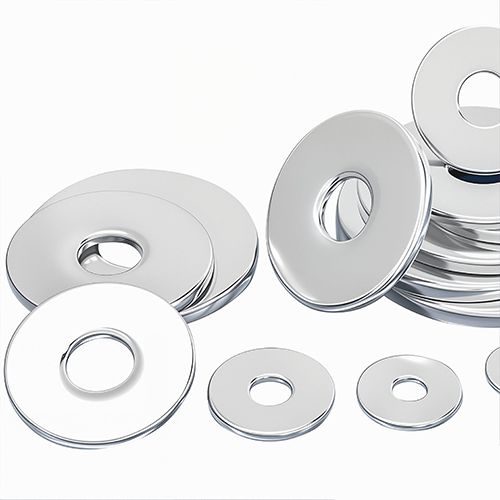
A maintenance team often discovers the grade problem after the first wet season. Washer faces show brown staining, tight crevices under the washer begin to pit, and bolts become difficult to remove. The pain is not only cosmetic; chloride pitting can reduce clamp load and create leak paths around flanges, skids, and pump bases. The solution is to match the washer grade to the chloride level, humidity, cleaning chemistry, and crevice risk. AISI 304 performs well in many indoor and mildly corrosive settings, but chlorides can break down its passive film, especially in stagnant wet crevices. AISI 316’s molybdenum content improves pitting resistance and crevice corrosion resistance. For buyers, this means specifying 316 washers where salt spray, seawater mist, chloride sanitizers, or de-icing salts are present. Ningbo Kaxite Sealing Materials Co., Ltd. can supply both grades and help define the finish, passivation, and packaging needed for export and long storage.
Table 2: Environment Match and Corrosion Rating
| Service Scene | AISI 304 Washer | AISI 316 Washer | Buyer Action |
|---|---|---|---|
| Dry indoor machinery | Suitable | Over-specified | Use 304 to control cost |
| Food washdown, mild cleaners | Usually suitable | Good for aggressive sanitation | Check chloride cleaner data |
| Coastal air, salt mist | High pitting risk | Recommended | Specify 316 and passivation |
| Marine deck hardware | Not preferred | Recommended | Use 316 with sealed crevices |
| Chemical process skid | Depends on chemistry | Often safer | Confirm with corrosion data |
The buying pain appears when a project team specifies 316 late, the mill lead time extends, and the fastener package becomes the critical path. Another common scene is a buyer who receives a 304 quotation and a 316 quotation without a clear basis for comparison. The solution is to compare total installed cost, not just piece price. AISI 316 usually carries a higher material cost because of nickel and molybdenum content, and availability can vary by size, standard, and surface finish. AISI 304 is widely stocked and often easier to source in standard flat washers. However, if 304 washers fail in a chloride environment, replacement labor, downtime, and warranty exposure can erase the savings. For high-volume standard sizes, buyers may combine 304 for indoor assemblies and 316 for exposed or washdown assemblies in one purchase order to balance stock and risk. Ningbo Kaxite Sealing Materials Co., Ltd. supports mixed-grade orders, standard and custom washer sizes, and export documentation for procurement teams.
Table 3: Procurement Comparison
| Procurement Factor | AISI 304 Washer | AISI 316 Washer |
|---|---|---|
| Relative material cost | Index 1.0 | Often 1.3–1.8× |
| Stock availability | Broad for standard sizes | Good but size-dependent |
| Lead-time risk | Lower for common M6–M12 | Confirm mill and finishing schedule |
| Best use of budget | Dry indoor, general fastening | Chloride, marine, washdown, critical joints |
| Documentation | MTC, dimensional report, PMI on request | MTC, PMI, passivation record on request |
Assembly teams often face a painful surprise: stainless washers and bolts can gall during tightening, especially in large diameters or high-speed installation. The washer may seize, the thread may pick up, and the joint may lose preload. The solution is to control lubrication, surface finish, and installation speed, and to use washers that match the bolt grade. AISI 304 and 316 washers are both austenitic stainless steels, so they share a tendency to gall when rubbed against similar stainless steel under pressure. A clean, passivated surface helps, but a suitable anti-seize lubricant may be needed for critical joints. Buyers should also confirm washer thickness and hardness so the washer does not cup or deform under the target clamp load. For projects with high torque or repeated assembly, specify the washer standard, surface condition, and lubrication requirement in the purchase order. Ningbo Kaxite Sealing Materials Co., Ltd. can review drawings and provide washers with controlled dimensions, edge finish, and packaging suitable for assembly lines.
Table 4: Installation and Washer Dimension Reference
| Metric Size | Typical ID | Typical OD | Typical Thickness | Assembly Note |
|---|---|---|---|---|
| M6 | 6.4 mm | 12 mm | 1.6 mm | Check washer flatness |
| M8 | 8.4 mm | 16 mm | 1.6 mm | Use lubrication if galling appears |
| M10 | 10.5 mm | 20 mm | 2.0 mm | Confirm clamp load and thickness |
| M12 | 13 mm | 24 mm | 2.5 mm | Control installation speed |
A buyer may face pressure to standardize every washer on one grade to simplify inventory. The pain appears when one line uses a chloride cleaner and another stays dry, yet both receive the same 304 washer. The solution is to map the plant by exposure, not by convenience. AISI 304 washers are a sound choice for dry indoor frames, electrical cabinets, general machinery, and clean assembly areas with no chloride exposure. AISI 316 washers are the safer specification for coastal sites, marine equipment, chemical processing, pharmaceutical washdown, wastewater, and food plants using chloride-based sanitizers. In mixed plants, color-coding or bin labeling by grade reduces the chance of a 304 washer being pulled for a 316 job. Procurement can also require grade markings, mill certificates, and positive material identification for critical projects. Ningbo Kaxite Sealing Materials Co., Ltd. supports grade-specific packing and labels so warehouse teams can separate AISI 304 and AISI 316 stainless steel washers without confusion.
Table 5: Application Selection Guide
| Industry or Scene | Exposure | Recommended Washer Grade | Reason |
|---|---|---|---|
| Indoor equipment frames | Dry | AISI 304 | Good corrosion resistance and lower cost |
| Food and beverage washdown | Wet, cleaners | AISI 316 or 304 after review | Chloride cleaners raise pitting risk |
| Coastal construction | Salt mist | AISI 316 | Molybdenum improves chloride resistance |
| Marine and offshore | Seawater mist | AISI 316 | Safer under crevice and pitting conditions |
| Chemical process | Process-specific | AISI 316 or higher alloy | Verify chemical compatibility |
The pain scene is a delivery that arrives with the right dimensions but the wrong grade, no mill certificate, or mixed washers in one carton. The solution is a purchase order checklist that removes ambiguity before production begins. Start with the washer standard, such as ISO 7089, DIN 125, or ASTM F844, then add grade, dimensions, tolerance, surface finish, passivation requirement, and packaging. For AISI 316 projects, ask for the molybdenum range and consider positive material identification on critical lots. For export orders, confirm carton labels, pallet dimensions, and documents needed for customs. A clear checklist also helps the supplier quote faster and reduces back-and-forth on technical clarifications. Ningbo Kaxite Sealing Materials Co., Ltd. works with procurement teams to convert drawings, standards, and application notes into a controlled washer specification, then supplies AISI 304 or AISI 316 stainless steel washers with the requested traceability and packing.
Table 6: Purchase Order Checklist
| Checklist Item | What to Specify | Why It Matters |
|---|---|---|
| Grade | AISI 304, AISI 316, or 316L | Controls corrosion performance and price |
| Washer standard | ISO 7089, DIN 125, ASTM F844, ASME B18.22.1 | Prevents dimensional mismatch |
| Dimensions | ID, OD, thickness, tolerance | Ensures fit and clamp load |
| Surface | Pickled, passivated, clean, deburred | Improves passive film and handling |
| Documentation | MTC, dimensional report, PMI if required | Supports quality and traceability |
| Packing | Grade label, quantity per bag, export pallet | Avoids mixed stock and shipping damage |
Q1: What Is the Difference Between AISI 304 and 316 Stainless Steel Washers? The main difference is molybdenum. AISI 304 contains chromium and nickel but no intentional molybdenum, while AISI 316 contains 2–3% molybdenum. That addition improves resistance to chloride pitting and crevice corrosion, which is why 316 washers are preferred for coastal, marine, washdown, and chemical exposure. AISI 304 washers remain a cost-effective choice for dry indoor and general fastening where chlorides are not present.
Q2: Can I substitute AISI 316 washers for 304 washers without changing the bolt? In many cases, yes, but the joint should be reviewed as a system. A 316 washer with a 304 bolt may be acceptable in some assemblies, but the exposed bolt head may still corrode in a chloride environment. For critical outdoor or marine joints, match the washer, bolt, and nut to the same corrosion class or confirm the design with an engineer. Also check galling risk and lubrication requirements before assembly.
Q3: How can a buyer verify that the washers are truly AISI 304 or AISI 316? Ask for a mill test certificate that lists the chemical composition, including chromium, nickel, and molybdenum. For critical lots, request positive material identification or a third-party inspection. Check the grade marking and packing label against the purchase order. A supplier that understands export procurement will provide documents before shipment, not after the cartons arrive.
Q4: Are 316 washers always the better choice? No. AISI 316 is better only when its chloride resistance is needed. In dry indoor equipment, 304 washers can provide a long service life at a lower cost. Over-specifying 316 can raise material cost and lead-time risk without improving performance. The right choice comes from matching the washer grade to the actual environment, cleaning chemicals, humidity, and crevice conditions.
Ningbo Kaxite Sealing Materials Co., Ltd. supports procurement teams that need clear grade selection, stable dimensions, and export-ready supply for stainless steel washers and sealing products. From the first inquiry, the team can help compare AISI 304 and AISI 316 stainless steel washers, confirm standards such as ISO 7089, DIN 125, ASTM F844, and ASME B18.22.1, and prepare quotations based on size, finish, documentation, and annual volume. Buyers can visit https://www.ring-joint-gaskets.net to review product information, then send drawings or application details to [email protected] for a technical review. Share the service environment, chloride exposure, target torque, and packing requirements, and the Ningbo Kaxite Sealing Materials Co., Ltd. team will help turn those details into a practical washer specification and a reliable supply plan.
Lo, K.H., Shek, C.H., and Lai, J.K.L., 2009. Recent developments in stainless steels. Materials Science and Engineering: R: Reports, 65(4–6).
Ryan, M.P., Williams, D.E., Chater, R.J., Hutton, B.M., and McPhail, D.S., 2002. Why stainless steel corrodes. Nature, 415(6873).
Olsson, C.O.A., and Landolt, D., 2003. Passive films on stainless steels—chemistry, structure and growth. Electrochimica Acta, 48(9).
Pardo, A., Merino, M.C., Coy, A.E., Viejo, F., Arrabal, R., and Matykina, E., 2008. Pitting corrosion behaviour of austenitic stainless steels – combining effects of Mn and Mo additions. Corrosion Science, 50(6).
Baddoo, N.R., 2008. Stainless steel in construction: A review of research, applications, challenges and opportunities. Journal of Constructional Steel Research, 64(11).
Gardner, L., 2005. The use of stainless steel in structures. Progress in Structural Engineering and Materials, 7(2).
Ningshen, S., Mudali, U.K., Mittal, V.K., and Khatak, H.S., 2007. Semiconducting and passive film properties of nitrogen-containing type 316LN stainless steels. Corrosion Science, 49(2).
Ilevbare, G.O., and Burstein, G.T., 2001. The role of alloyed molybdenum in the inhibition of pitting corrosion in stainless steels. Corrosion Science, 43(3).
Olefjord, I., and Wegrelius, L., 1996. The influence of nitrogen on the passivation of stainless steels. Corrosion Science, 38(8).
Maurice, V., and Marcus, P., 2018. Current developments in corrosion and passivation of stainless steels. Electrochimica Acta, 276.
-