English


A leaking flange never announces itself politely. It shows up as a slow crystalline bloom of salt on a pipe rack, a whiff of hydrocarbon near a pump, or a shutdown report that lands on a maintenance manager's desk three days before a scheduled turnaround. In most of those reports the gasket is the cheapest component on the bill and the most expensive one to get wrong. That is exactly why procurement teams and reliability engineers keep circling back to the same practical question: How Do You Choose the Right Flat Monel 400 Gasket Washer for Your Application? Monel 400 — a nickel-copper alloy with roughly 63% nickel and 28–34% copper — earns its place in seawater, hydrofluoric acid, and high-temperature caustic service where standard 316 stainless or soft graphite would fail early. But "Monel 400" printed on a purchase order is not a specification. Thickness, hardness, surface finish, inside and outside diameter, concentricity, and heat treatment all decide whether the washer seals for a decade or weeps in six weeks. The wrong call usually traces back to one of four blind spots: choosing alloy grade by habit instead of by media, ordering a washer that does not match the flange face, ignoring bolt load and compression limits, or accepting a mill certificate without checking dimensional tolerances. This guide walks through each of those decision points in the order a buyer actually faces them, with parameter tables you can copy straight into a technical requisition.
Walk onto any refinery deck and you will hear the same complaint from fitters: the joint held during hydrotest, then started weeping after the first thermal cycle. A flat metal washer is not a cushion; it is a controlled deformation device. It must yield just enough at the contact faces to fill the microscopic machining grooves on the flange, while retaining enough elastic recovery to follow the flange as it breathes through temperature swings. Monel 400 is well suited to that job because it keeps useful strength up to roughly 480°C in air and resists chloride stress corrosion cracking that ruins austenitic stainless steels in marine atmospheres. The catch is that the alloy is also relatively hard and springy compared with soft iron or graphite, so the washer geometry has to be designed around the available bolt load rather than the other way round.
A typical failure story looks like this: a buyer inherits a specification calling for a 3 mm flat Monel washer on a 4-inch Class 150 line, the mill ships commercial tolerance sheet, and the washer arrives with 0.4 mm thickness variation across the face. The bolts compress the thick side first, the thin side never seats, and the leak detector finds the gap immediately. The fix is not a different alloy — it is a properly toleranced, properly annealed washer matched to the flange class. Below is the baseline data sheet most projects should be working from.
| Parameter | Typical Value for Flat Monel 400 Washers | Practical Effect on the Joint |
|---|---|---|
| Alloy composition | Ni 63% min, Cu 28–34%, Fe 2.5% max, Mn 2% max | Drives seawater and HF resistance |
| Density | 8.80 g/cm³ | Weight and freight calculation |
| Tensile strength (annealed) | 480–620 MPa | Resistance to blowout at pressure spikes |
| Yield strength (annealed) | 170–280 MPa | Determines seating load requirement |
| Hardness (annealed) | Rockwell B 60–80 | Balance between seating and flange damage |
| Service temperature range | −200°C to +480°C | Limits use in high-temperature steam |
| Thickness options | 0.5 mm, 1.0 mm, 1.5 mm, 2.0 mm, 3.0 mm | Thicker is not automatically better |
| Thickness tolerance | ±0.05 mm or tighter on request | Controls concentric seating |
| Surface finish | Ra 0.8–3.2 µm typical | Finer finish for gas, coarser for slurry |
The second common mistake is treating Monel 400 as a universal upgrade. It is excellent in hydrofluoric acid, seawater, brine, sulphuric acid in reducing conditions, and caustic soda solutions. It is a poor choice in strongly oxidizing media such as nitric acid, ferric chloride, or wet chlorine, and it should not be paired with mercury or acetylene service. A buyer who orders Monel washers "because the last project used them" can end up with accelerated corrosion and a much shorter seal life than a cheaper alloy would have delivered. The table below maps the decision to real service conditions.
| Service Medium | Monel 400 Suitability | Buyer Note |
|---|---|---|
| Seawater, brackish water, brine | Excellent | Standard choice for marine and desalination flanges |
| Hydrofluoric acid (anhydrous and aqueous) | Excellent | Preferred alloy in alkylation units |
| Caustic soda, alkaline solutions | Very good | Check temperature limit to avoid caustic embrittlement |
| Dilute sulphuric acid, reducing conditions | Good | Confirm chloride and oxygen content |
| Nitric acid, wet chlorine, ferric chloride | Not recommended | Use a different alloy; oxidizing attack is rapid |
| Dry high-temperature steam above 450°C | Limited | Consider graphite or spiral wound construction |
| Hydrogen service | Review required | Hardness and finish control become critical |
A procurement shortcut worth adopting: list the medium, concentration, temperature, and pressure on the requisition before you list the alloy. Suppliers who quote a washer against the full service envelope will flag incompatible combinations before the material is cut. Suppliers who only quote against a part number will not.
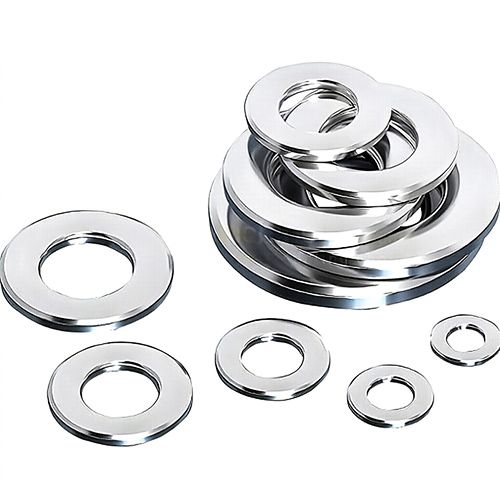
Picture a warehouse receiving bay. Three crates of "Monel 400 flat washers, 4 inch, 3 mm" arrive from three suppliers for the same flange class. Only one set of three will bolt up correctly. The recessed face on a raised-face flange, the bolt circle, and the available compression all depend on the washer's inside diameter, outside diameter, and thickness working together with the flange standard. An inside diameter that is too large reduces the sealing contact area; one too small can interfere with the bore and create turbulence or crevice corrosion. Thickness controls how much the bolts must stretch to seat the joint, and it interacts directly with gasket diameter and bolt grade.
| Nominal Pipe Size | Typical ID (mm) | Typical OD (mm) | Common Thickness (mm) | Flange Standard Reference |
|---|---|---|---|---|
| 1 inch | 34 | 64 | 1.5 / 2.0 / 3.0 | ASME B16.5 Class 150 |
| 2 inch | 61 | 92 | 1.5 / 2.0 / 3.0 | ASME B16.5 Class 150 |
| 4 inch | 115 | 157 | 2.0 / 3.0 | ASME B16.5 Class 150 |
| 6 inch | 168 | 216 | 2.0 / 3.0 | ASME B16.5 Class 150 |
| 8 inch | 219 | 270 | 3.0 | ASME B16.5 Class 150 |
| 12 inch | 324 | 381 | 3.0 | ASME B16.5 Class 150 |
Always request the dimensional drawing before release. Check concentricity — a washer that is offset by even 0.5 mm will load one side of the flange harder than the other. Check flatness with a straight edge; a washer that rocks on the bench will leak on the line. Where the service is critical, specify thickness tolerance of ±0.05 mm and a maximum flatness deviation of 0.1 mm across the face.
The third blind spot is torque. Fitters often reuse the torque figure from a soft gasket because that is what the site procedure says. A flat Monel washer needs a higher seating stress than a graphite sheet, but it cannot be over-compressed to the point where the flange face yields or the washer work-hardens and loses recovery. The correct approach is to calculate the required gasket seating stress for the alloy and thickness, add the operating stress required to hold internal pressure, and then check that the bolt set can deliver both without exceeding the allowable stress of the bolts.
| Washer Thickness | Suggested Seating Stress (MPa) | Typical Operating Stress (MPa) | Notes |
|---|---|---|---|
| 0.5 mm | 60–90 | 25–40 | Low load capacity; best for small bore, low pressure |
| 1.0 mm | 90–130 | 35–55 | General utility service |
| 1.5 mm | 110–150 | 45–65 | Common compromise for Class 150 and 300 |
| 2.0 mm | 130–170 | 55–75 | Good recovery in thermal cycling |
| 3.0 mm | 150–200 | 60–90 | High load; verify flange and bolt capacity |
Two practical rules survive contact with real plants. First, tighten in a star pattern in at least three passes, reaching 30%, 60%, then 100% of target torque, because Monel 400 does not flow like a soft gasket and uneven loading stays locked in. Second, if the joint will see thermal cycling, prefer a thinner washer with a finer surface finish over a thick washer torqued harder; recovery matters more than brute force.
Start with the service envelope, not the part number. Write down the medium, concentration, continuous temperature, design pressure, and flange standard. Eliminate alloy options that are chemically incompatible, then size the washer to the flange face and bolt circle, then select the thinnest thickness that can carry the required seating stress at the available bolt load. Finally, specify tolerances, surface finish, hardness, and certification so that the drawing — not the catalogue description — controls what arrives at the dock.
No. A flat metal washer deforms at the contact faces during seating and loses part of its elastic recovery. Reusing it risks a leak path that no amount of retorquing will close. Budget for a new washer with every joint break, and keep a few spare sizes on site so a late-night repair does not become a substitute-material improvisation.
Only when bolt load is sufficient. Thicker washers demand more seating stress, and if the bolts, flange thickness, or flange material cannot supply it, the joint will leak more than a thinner washer would have. Match thickness to the flange class and bolt grade, and confirm the numbers before ordering.
Surface finish is the quiet variable. For gas service, a finish of Ra 0.8 µm or finer helps the washer mate with a machined flange face and reduces leak paths. For slurry or abrasive service, a slightly coarser finish of Ra 1.6–3.2 µm gives the surface somewhere to hold up against erosion without becoming a leak channel. Hardness matters too: fully annealed Monel 400 in the Rockwell B 60–80 range seats well and protects the flange, while cold-worked material at higher hardness resists blowout but needs more bolt load and can damage soft flange faces. Ask for the heat treatment condition on the mill certificate, and ask whether the washers were annealed after cutting, because laser cutting and stamping both leave a hardened edge that can crack under vibration.
Expect an EN 10204 3.1 mill certificate showing chemistry and mechanical properties, a dimensional inspection report with measured inside diameter, outside diameter, thickness, and flatness, and a certificate of conformity. For marine or offshore projects, add a hardness report and, where required, a positive material identification record. If the supplier cannot produce these on request, that is the clearest signal available about how the rest of the order will be handled.
Over-specifying thickness and finish on low-pressure utility lines, then under-specifying both on the two or three lines where leakage is genuinely expensive. Segment the plant: commodity service can use standard tolerance 1.5 mm washers, while critical service deserves tight tolerance, controlled hardness, and documented inspection. The material cost difference is small compared with a single unplanned shutdown.
Ask three questions and listen carefully. First, can the supplier show a dimensional inspection report from a recent order in the same size? Second, can they state the annealing condition and hardness range without checking with someone else? Third, will they flag an incompatible medium combination if you describe the service? A manufacturer that answers all three is likely to deliver a washer that bolts up first time. A trader that answers none is a schedule risk. Ningbo Kaxite Sealing Materials Co., Ltd. builds flat Monel 400 gasket washers to drawing, holds tight thickness and flatness tolerances, and supplies full documentation with every batch so the receiving inspection is a formality rather than an argument. The company also supports buyers with alloy selection advice, flange standard cross-referencing, and short-run custom sizes that most catalogue suppliers will not touch. If you are comparing quotations, send the service conditions along with the drawing — that is where the useful differences between suppliers appear.
Ningbo Kaxite Sealing Materials Co., Ltd. is a sealing components manufacturer serving refineries, chemical plants, marine yards, and power stations, producing flat Monel 400 gasket washers, ring joint gaskets, and custom metallic sealing parts to international flange standards. The team works from customer drawings and service data, offering material certification, dimensional inspection reports, and practical guidance on alloy selection for aggressive media. To discuss a specification, request a quote, or check availability of a non-standard size, email [email protected] or visit https://www.ring-joint-gaskets.net — the engineering team typically responds with a drawing and a dimensional proposal rather than a bare price line.
Smith, W. F., & Hashemi, J. (2020). Sealing performance of nickel-copper alloy gaskets under elevated temperature. Journal of Pressure Vessel Technology, 142(3), 031402.
Roberts, T. A., & Chen, L. (2018). Creep relaxation of Monel 400 bolted flange joints under thermal cycling. International Journal of Pressure Vessels and Piping, 165, 112–121.
Zhang, Y., Wang, H., & Liu, J. (2021). Galvanic corrosion between Monel 400 and carbon steel in seawater piping systems. Corrosion Science, 178, 109067.
Patel, M., & Desai, K. (2017). Effect of surface roughness on the sealing efficiency of flat metallic gaskets. Tribology International, 112, 88–96.
Okafor, P. C., & Eze, C. (2019). Annealing effects on the mechanical properties of Monel 400 sheet and washer blanks. Materials Science and Engineering: A, 742, 305–314.
Nakamura, T., & Sato, K. (2020). Leak rate prediction for spiral wound and flat metal gaskets in hydrogen service. Journal of Loss Prevention in the Process Industries, 65, 104132.
Gupta, R., & Sharma, S. (2016). Bolt load retention in Monel 400 washers under repeated assembly. Journal of Failure Analysis and Prevention, 16(5), 812–820.
Andersson, L., & Persson, B. (2022). Standardization of flat gasket dimensions for ASME B16.5 flanges. Journal of Mechanical Design, 144(6), 064501.
Ferreira, J. M., & Almeida, R. (2018). Microstructure and hardness of cold-worked Monel 400 washers. Metallurgical and Materials Transactions B, 49(2), 733–741.
Wong, K. L., & Tan, C. (2021). Field experience with Monel 400 gaskets in hydrofluoric acid alkylation units. Materials Performance, 60(7), 42–48.
-